Coal tar sealer installation
How coal tar sealer is installed: surface prep, coverage math, the two-coat sequence, cure times, and the point where a driveway should not be sealed.
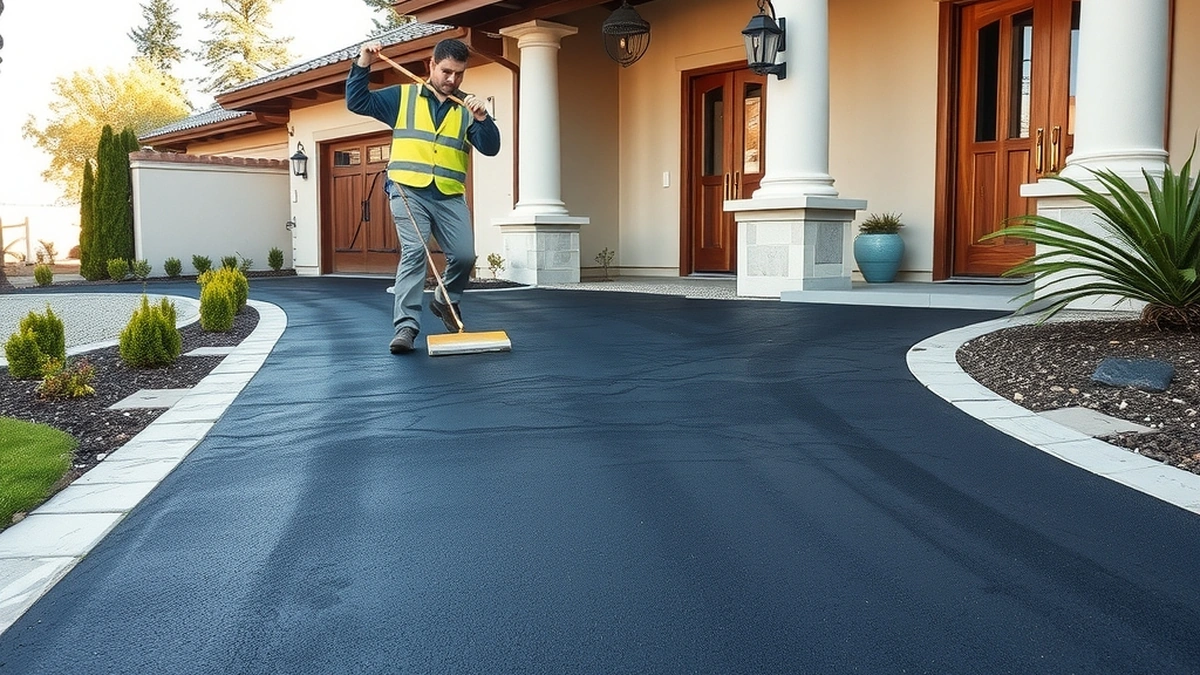
Coal tar sealer installation means cleaning the pavement, filling cracks and patching holes, then applying two thin coats at the label's coverage rate with a full cure between them. Prep decides the outcome more than the product does.
- Coats required
- 2
- Label coverage
- 50-100 sq ft per gallon
- Vehicle traffic
- 48-72 hours
- Installed cost
- $0.15-0.30 per sq ft
Some links on this page are affiliate links.If you buy through them we may earn a commission at no extra cost to you. We do not accept payment for rankings. Read the full disclosure.
Coal tar sealer installation is a prep job with a coating attached to the end of it. The pavement gets cleaned, cracks get filled, holes get patched, and then two thin coats go down at the coverage rate printed on the pail, with a full cure between them. Most failed installations fail in the first three steps, not the last two.
What the product is and what it does
Coal tar sealer is a refined coal-tar emulsion blended with water, clay filler, and often a polymer additive, applied as a protective film over asphalt.
The film blocks ultraviolet light, slows surface oxidation, and resists oil and gasoline spills. It does not add structural strength. On a driveway with a sound base it buys years of appearance and a slower route to replacement; on a failing base it buys a season at most.
Materials and quantities
Work the quantity out before you leave for the supplier. Divide the driveway area by the label’s coverage rate to get gallons per coat, then double it.
| Driveway size | Gallons per coat at 80 sq ft/gal | Two coats | Five-gallon pails |
|---|---|---|---|
| 500 sq ft | 6.25 | 12.5 | 3 |
| 1,000 sq ft | 12.5 | 25 | 5 |
| 2,000 sq ft | 25 | 50 | 10 |
A 1,000 square foot drive at 80 square feet per gallon is 1,000 ÷ 80 = 12.5 gallons per coat, so 25 gallons for two coats, and 25 ÷ 5 = 5 pails. Buy one pail over the calculation for edges, the apron, and porous patches, because running short halfway across the drive leaves a visible seam that cannot be blended later.
Alongside the sealer you need crack filler, a blower or stiff broom, a degreaser, a squeegee or sprayer, a tamper for patches, gloves, eye protection, and barricades.
Surface preparation decides the job
- Clear and blow the surface. Remove vehicles, grit, leaves, and sand, paying attention to the joint at the garage slab where debris collects.
- Wash and degrease. Scrub oil spots with a degreaser, then rinse the whole drive and let it dry for at least 24 hours.
- Fill cracks over 1/8 inch. Crack filler costs $2 to $5 per linear foot, so sixty feet is $120 to $300 (60 × $2 = $120; 60 × $5 = $300). Overfill slightly and tamp flush.
- Patch potholes. Cold patch or hot mix at $100 to $400 per hole, tamped in lifts rather than one deep fill.
- Prime bare or oily patches so the new film bonds to the repair instead of sitting on it.
Preparation is also where the schedule breaks. Sealer applied to a damp surface traps moisture and blushes white within weeks, and there is no fix short of stripping the coat.
Applying the two coats
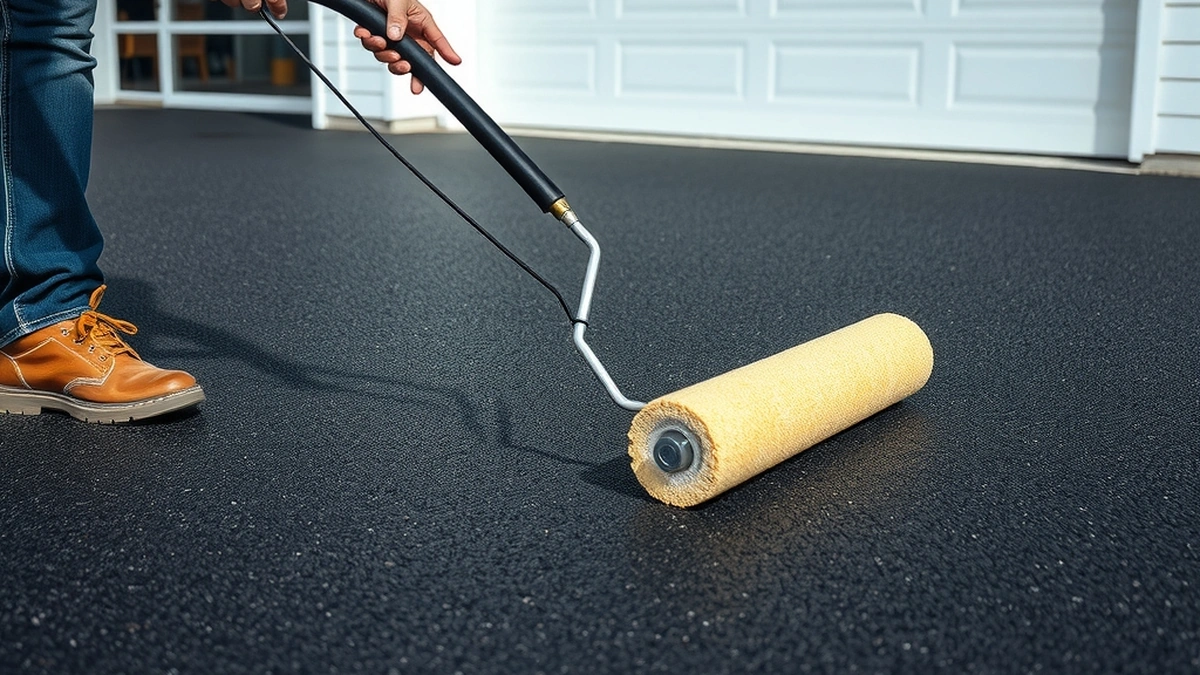
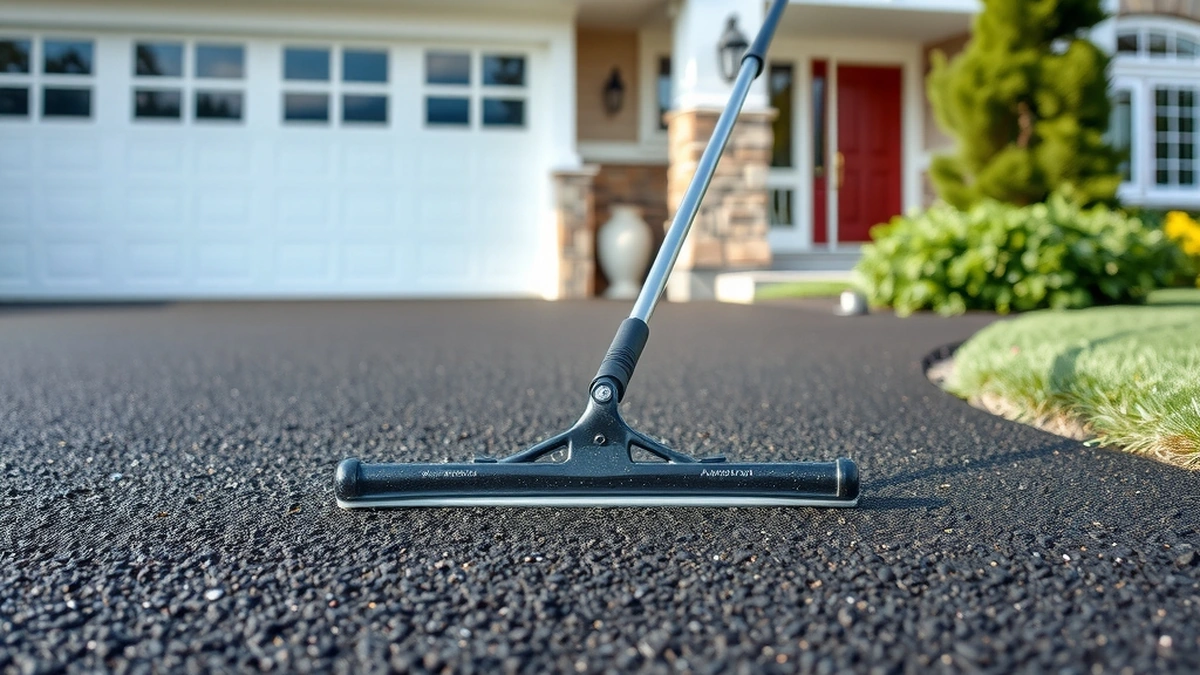
Apply the first coat at the label rate, working from the top of the slope downward so you are not standing in fresh material. Keep a wet edge and overlap each pass by a few inches. On edges, cut in with a brush before the flat work so the border is not starved.
Let the first coat cure according to the label, typically a few hours to overnight in warm dry weather, then apply the second coat at right angles to the first. Two thin coats build an even film; one heavy coat skins over, traps solvent, and cures unevenly underneath.
Do not walk on the surface between coats unless the label permits it, and do not try to stretch the last pail by thinning the second coat. A thin second coat is the most common reason a drive greys out in one season.
Cure times and traffic
| Stage | Typical timing | Notes |
|---|---|---|
| Touch dry | 2-6 hours | Do not walk on it |
| Foot traffic | 24 hours | Shoes only, no pets |
| Vehicle traffic | 48-72 hours | Longer in cool or humid weather |
| First wash | 2-4 weeks | Gentle rinse, no pressure |
Heat shortens the cure and cold extends it. A coat applied at 60°F and high humidity can still be soft at 72 hours, and tyres turning on it will leave permanent marks. If rain is forecast inside the cure window, wait.
Where installation should stop
Do not seal over alligator cracking, depressions, or edge crumbling. Those patterns mean the base has moved or softened, and a surface film cannot correct either. The honest next step is driveway sealing repair, and if the damage is widespread, an asphalt overlay cost of $3 to $7 per square foot is $3,000 to $7,000 on 1,000 square feet, against $8,000 to $15,000 for full replacement at $8 to $15 per square foot.
Coal tar installation vs emulsion installation: the sequence is identical, but coal tar needs heavier coverage per square foot, cures darker, and is more sensitive to legal restrictions. Emulsion is thinner, faster to cure, and easier to source where coal tar is banned. Types of driveway sealing sets out the full menu.
Runoff, safety, and disposal
Coal tar carries high levels of polycyclic aromatic hydrocarbons, which is the reason for the restrictions in several states and municipalities. Keep the material out of storm drains and away from the street gutter, use a containment berm on sloped drives, and never hose leftovers into the road.
Wear gloves and eye protection, keep the area clear of pets and children until the film is fully cured, and dispose of pails and rinse water at a household hazardous waste site rather than in the trash. If you would rather not handle any of that, driveway sealing near me covers what a contractor’s price should include — and coal tar sealer cost shows what the installed rate looks like on paper.
Frequently asked questions
How long before I can drive on fresh coal tar sealer?
Typically 48 to 72 hours in warm dry weather. Cool or humid conditions extend that, and turning tyres on a soft film will leave marks that never come out.
Can coal tar sealer be sprayed instead of squeegeed?
Yes. Spray application is faster on large areas, but it needs masking and careful overlap, and squeegee work still gives better control on edges and small drives.
How many gallons does a 1,000 square foot driveway need?
At a label rate of 80 square feet per gallon per coat, it needs 12.5 gallons per coat, or 25 gallons for two coats, which is five five-gallon pails.
Do I have to fill cracks before sealing?
Yes, any crack over 1/8 inch. Sealer bridges a crack for a season at most, and water moving under the film breaks the bond from below.
Can I apply coal tar sealer over an old emulsion coat?
Only if the old coat is sound and clean. Loose or flaking sealer has to come off first, or the new film will lift with it.
Is coal tar sealer legal everywhere?
No. Several states and municipalities restrict or ban coal tar sealant sales because of polycyclic aromatic hydrocarbon runoff. Check local rules before buying.
Sources
Some links are affiliate links.If you buy through them we may earn a commission at no extra cost to you. We do not accept payment for rankings. Read the full disclosure.