Puddling: warning signs of a drainage fault
Signs a puddle is a real fault: water still there after 24 hours, a dark ring at the edge, silt deposits, and soft pavement underfoot. What each one means.
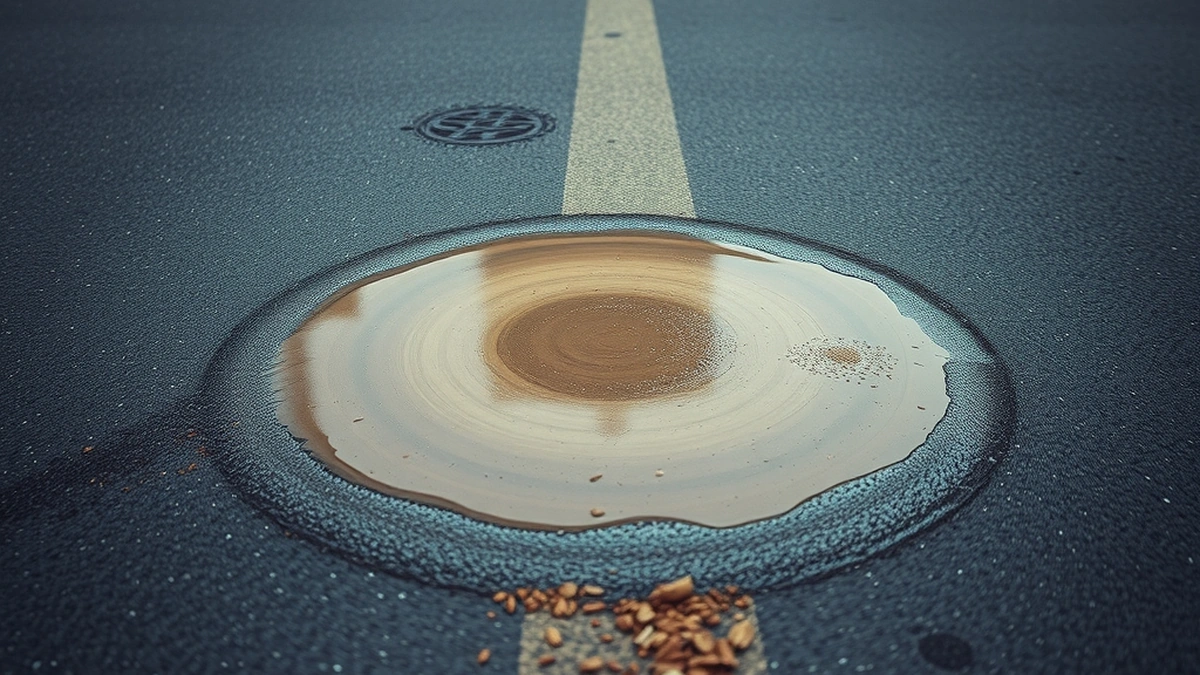
The warning signs of a driveway drainage fault are water still standing 24 hours after rain, a dark tide line around the puddle, silt or debris deposited at its edge, and pavement that feels soft underfoot. Any two together mean the base is being damaged.
- Fault threshold
- Water gone within 24 hours
- First sign
- Water still there next day
- Second sign
- Dark tide line at the edge
- Third sign
- Soft pavement underfoot
- Repair cost
- $100-$400 per low spot
Some links on this page are affiliate links.If you buy through them we may earn a commission at no extra cost to you. We do not accept payment for rankings. Read the full disclosure.
The main warning sign of a driveway drainage fault is water still standing 24 hours after rain. A shallow film that dries in a few hours is normal. Water that survives the day is sitting on pavement that is out of plane, and it is softening the base underneath while it waits to evaporate.
The 24-hour rule
Pavement drains by slope. On a correctly built driveway, rain runs off within minutes and the surface dries in the sun and wind.
Water that remains after a day is not draining, which means one of three things: the surface has settled into a bowl, the fall was never enough, or water is arriving from somewhere else.
The rule is a useful threshold because it filters out the harmless cases. A puddle after a downpour is not a fault. A puddle the next morning is.
The signs, and what each means
| Sign | What it looks like | What it means |
|---|---|---|
| Water after 24 hours | Standing pool, still there next day | Surface out of plane |
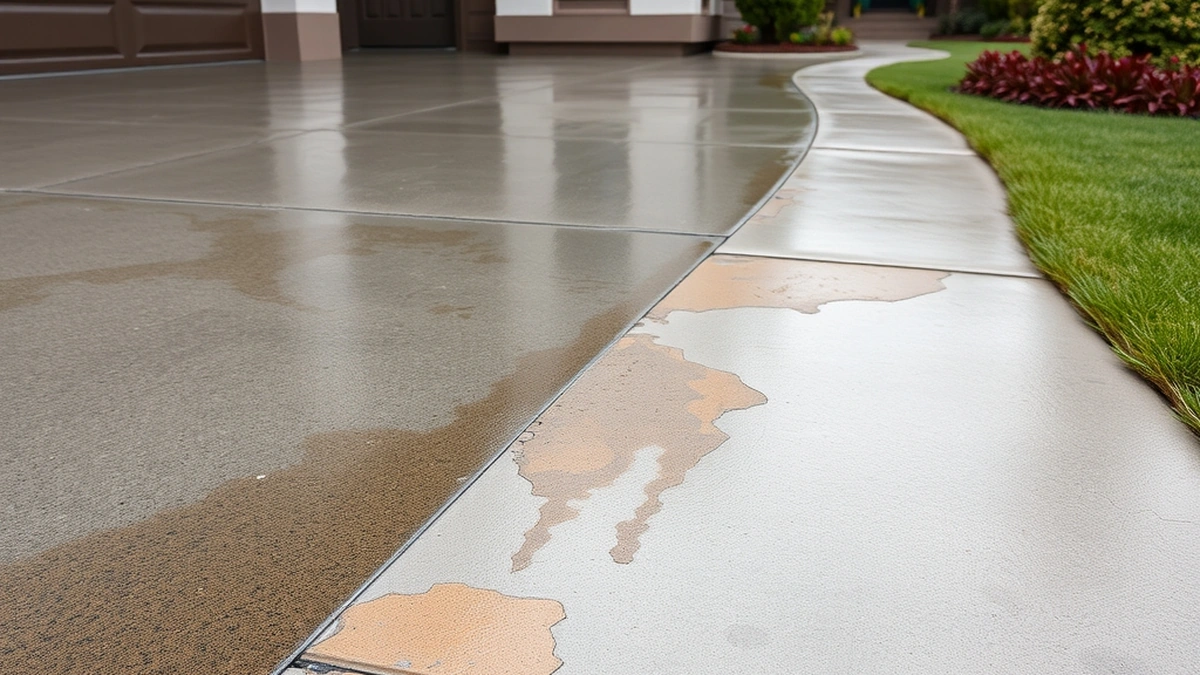
| Tide line | Dark ring around the pool | Recurring puddle |
| Silt ring | Grit or soil at the edge | Water carrying material in |
| Soft pavement | Gives underfoot | Base saturated |
| Moss or algae | Green growth in the low spot | Persistent moisture |
| Cracking at the rim | Cracks around the puddle edge | Edge of the bowl failing |
| Debris collection | Leaves and grit gather there | Flow is being interrupted |
Two or more of those together is confirmation. A tide line plus soft pavement is a drainage fault that is already damaging the base.
Why the tide line matters
A tide line is the residue left at the high-water mark each time the puddle dries. It is dark, often slightly raised, and it follows the shape of the pool.
Its value is that it records history. A puddle that appears once in a decade does not leave a tide line. A puddle that forms after every significant rain leaves a distinct ring, and the ring grows as the depression deepens.
If you are deciding whether to spend money on drainage, the tide line is the evidence.
Testing for soft pavement
Press a boot firmly into the pavement inside the puddle line. Compare it with a dry area a few feet away.
If the wet area gives more, or if a screwdriver sinks into it easily, the base has softened. That is the point at which the problem stops being cosmetic.
Soft pavement under a recurring puddle is the mechanism behind potholes. Traffic flexes the unsupported surface, it cracks, and the pieces work loose. Our potholes signs guide covers that progression.
What the signs cost to ignore
A puddle left alone does not stay the same size. Water softens the base, the base compresses, and the depression deepens, which holds more water.
The repair cost scales with that.
Early, a local low spot: patch and correct the base, $100 to $400. Later, several linked low spots: patching each, $400 to $1,200. Later still, widespread ponding: an overlay at $3 to $7 per square foot, $1,800 to $4,200 on 600 square feet. Worst case, base failure: replacement at $8 to $15 per square foot, $4,800 to $9,000.
The first number is the one worth paying.
Signs that point to off-site water
Some puddles are not the driveway’s fault. They are fed from somewhere else, and the fix is upstream.
Look for these patterns:
The puddle sits at the apron or the edge nearest the house, where a downspout discharges.
Water arrives across the pavement from a lawn that slopes toward it.
The puddle forms at the low end of the drive, where the street gutter is blocked or the outlet is buried.
In each case, patching the puddle without moving the water is a repeat purchase. Our puddling prevention guide covers the fixes.
Signs that are not a drainage fault
Three lookalikes are worth ruling out.
Oil stains. Dark patches that do not follow rainfall and do not have a tide line.
Shade dampness. A patch that stays damp under a tree but has no standing water is a drying problem, not a drainage one.
Fresh sealer sheen. A newly sealed driveway can look wet for a few days while the film cures. That is normal and passes.
The distinguishing test is standing water after 24 hours, measured with a straightedge or a level.
When to act, and how to record it
Act when any of these is true: water stands for more than a day, a tide line appears, the pavement inside the puddle line feels soft, or moss is growing in the low spot.
A single puddle that dries within hours after an exceptional storm is not a fault and does not need work.
If you are unsure, photograph the spot during rain and again the next morning. The comparison settles it, and it is also the most useful thing to show a contractor.
Recording the evidence.
- Photograph the puddle during rain and 24 hours later.
- Measure the puddle’s longest and widest dimensions.
- Note the depth against a straightedge laid across it.
- Record whether the pavement beneath is soft.
- Note any water source uphill or beside the spot.
Five items, one phone, ten minutes. That record tells a contractor more than a description, and it tells you whether the problem is growing year on year.
Our puddling repair guide covers the fix once the fault is confirmed, and puddling cost prices each option.
Frequently asked questions
How long should water stay on a driveway after rain?
No more than 24 hours. A shallow film that dries within a few hours is normal. Water still standing the next day is a drainage fault and will damage the base if left.
What is a tide line on a driveway puddle?
A dark ring left where water has stood and dried repeatedly. It marks the high-water level and shows the puddle is recurring rather than a one-off from an exceptional storm.
Why is the pavement soft under a puddle?
Because water has penetrated and softened the base. Softness underfoot means the pavement has lost support, which is the start of settlement and potholes.
Is a small puddle worth fixing?
Yes, if it recurs. Small puddles soften the base beneath them, and the depression deepens each season. A $100 to $400 patch now avoids an overlay later.
Can puddling be a sign of a broken drain?
It can. If the driveway has a drain, a blocked or collapsed outlet shows up as water backing up at the low point rather than flowing away.
Does moss or algae indicate a puddling problem?
Often. Moss and algae need persistent moisture, so growth in a low spot or along an edge is evidence that water sits there long enough to support it.
Sources
Some links are affiliate links.If you buy through them we may earn a commission at no extra cost to you. We do not accept payment for rankings. Read the full disclosure.