Potholes: warning signs before the hole opens
A pothole starts as a dark patch, a hairline crack, or a soft spot that holds water. The early signs, what each means, and why a $150 patch beats a $400 one.

The warning signs of a pothole are a dark damp patch that stays wet after rain, a crack that has begun to spall at the edges, a soft spot that deflects underfoot, and loose aggregate around a depression. Catching them early turns a $400 repair into a $100 to $200 one.
- First sign
- Dark patch that stays damp
- Next sign
- Spalling at crack edges
- Confirmation
- Soft spot underfoot
- Small patch
- $100-$200
- Patch with base repair
- $300-$400
Some links on this page are affiliate links.If you buy through them we may earn a commission at no extra cost to you. We do not accept payment for rankings. Read the full disclosure.
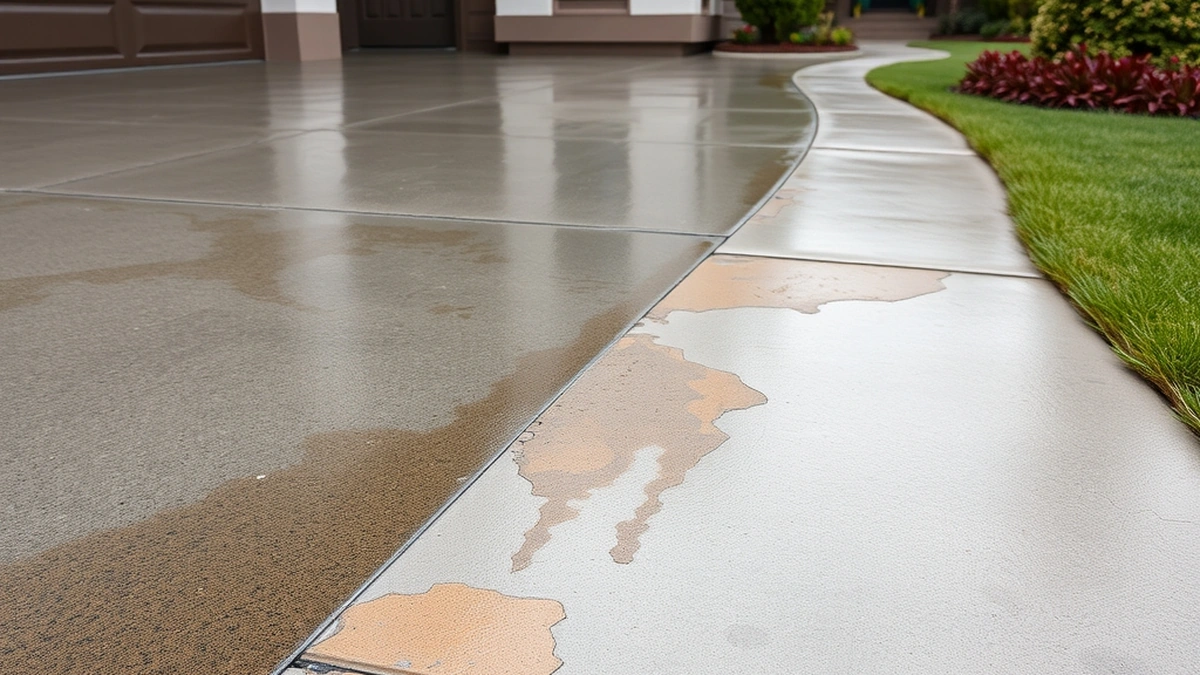
A pothole rarely appears without warning. It starts as a dark patch that stays wet, a crack with crumbling edges, or a soft spot that gives underfoot — all signs that water is in the pavement and the base has begun to lose support. Reading those signs early is the difference between a $150 patch and a $400 one with base work.
What is happening under the surface
A pothole is the last stage of a process that starts with water entering the pavement.
Water reaches the base through a crack, a failed joint, or a porous surface. The base softens, the pavement above it loses support, and traffic flexes the unsupported area until it breaks.
Once the surface breaks, the pieces work loose and traffic lifts them out. That is the hole.
The signs in order
| Stage | Sign | What it means | Action |
|---|---|---|---|
| 1 | Dark patch that stays damp | Water trapped in the surface | Check drainage |
| 2 | Hairline crack with dusty edges | Surface opening | Fill at $2-$5 per linear ft |
| 3 | Crack edges spalling | Pavement breaking at the opening | Fill and monitor |
| 4 | Loose grit in a shallow dip | Surface losing material | Patch at $100-$200 |
| 5 | Soft spot underfoot | Base saturated | Patch with base repair |
| 6 | Open hole | Surface failed | Patch at $100-$400 |
Stage 1 and 2 are the cheap interventions. Stage 5 and 6 are the expensive ones, and stage 5 is where base work starts to appear on the invoice.
Reading a dark patch correctly
Not every dark patch is a pothole forming. Oil stains, shade, and recent washing all darken asphalt.
The distinguishing feature is persistence. A patch that is still dark two days after rain, when the surrounding surface has dried, is holding water in the pavement rather than on it.
Check it with a finger. If the surface there feels softer or more granular than the surrounding asphalt, water is already working on the binder and the base.
Why edges fail first
Driveway edges crumble and break before the middle of the pavement, and that is where many potholes start.
The edge has less support than the interior. Where the pavement meets soil, there is often no compacted shoulder, so water runs along the joint and under the slab.
Turning wheels also load the edge more heavily than straight-line traffic, and power steering scrubs the surface at the apron.
If the edge is already crumbling, fix it before the failure reaches the driving surface. Our edge crumbling repair guide covers the sequence.
What each stage costs
Stage 2, filling a crack: 20 linear feet at $3 = $60. Stage 4, patching a small shallow area: $100 to $200. Stage 5, patching with base repair: $300 to $400. Stage 6, an open pothole: $100 to $400, plus the risk of the hole growing while you wait.
The numbers move in one direction. There is no stage at which waiting reduces the cost.
The inspection that catches stage 1
Walk the driveway after rain, not before. Water shows you exactly where the pavement is failing.
- Look for patches that stay dark after the rest has dried.
- Note any crack wider than a quarter inch and mark it with chalk.
- Press a boot or a screwdriver into suspect areas to test for softness.
- Watch where water runs and where it stands.
- Photograph anything you mark, so next year’s comparison is honest.
Ten minutes after a rainstorm tells you more than an hour of looking at dry pavement.
Photograph anything you mark, and keep the photos in one place with the date. A pothole that has doubled in a year is visible in a pair of images in a way it never is from memory, and that evidence is also the most useful thing you can hand a contractor when asking for a quote.
When a soft spot means base failure
A soft spot is the most serious of the early signs, because it means the base has lost support rather than the surface merely wearing.
Probe it with a screwdriver. If the tool sinks easily, or if water wells up, the base is saturated and no surface repair will hold.
The options at that point are a localised base repair, an overlay at $3 to $7 per square foot if the area is broad, or replacement at $8 to $15 if the base has failed across the driveway.
Patching a soft spot without correcting the base produces a repair that fails within a season, and the money is spent twice.
Preventing the progression
Three habits stop the sequence at stage 1 or 2.
Fill cracks before winter, at $2 to $5 per linear foot, so water cannot get in and freeze.
Seal every two to four years at $0.15 to $0.30 per square foot, so the surface binder is protected.
Keep water moving away: grade, downspouts, and edge support all matter more than any coating.
Those three cost roughly $80 to $150 a year on a 600 square foot driveway. One pothole repair costs more than two years of that.
One more cost sits outside the repair menu: the damage a pothole does to a vehicle. A tire, a wheel, or an alignment bill can exceed the repair cost several times over, which is why a hole at stage 6 should be patched rather than avoided. Our potholes prevention guide covers the routine in detail, potholes repair covers the fix once a hole is open, and potholes cost prices each option.
Frequently asked questions
What are the early signs of a pothole?
A dark patch that stays damp after rain, a crack with crumbling edges, loose grit around a shallow depression, and a soft spot that gives underfoot. All four point to water in the pavement.
How long does it take a pothole to form?
One or two freeze-thaw cycles once water is in the pavement. A crack that is filled in autumn may become a hole by spring if it is left open through winter.
Can a pothole be fixed before it opens?
Yes. A crack filled at $2 to $5 per linear foot, or a small patch at $100 to $200, prevents the surface breaking up. Waiting until the hole is open usually adds base work.
Why does a soft spot mean a pothole is coming?
Softness means the base under the pavement has lost support, usually because it is wet. Traffic flexes the unsupported surface until it cracks and breaks away.
Is a dark patch always a pothole forming?
Not always. Oil and water both darken asphalt. A patch that stays dark for days after rain, when the rest of the driveway has dried, is the one to investigate.
What should I do at the first sign?
Clean and fill any crack, probe the area for softness, and correct drainage if water is standing. If the surface has already broken, patch it while the hole is small.
Sources
Some links are affiliate links.If you buy through them we may earn a commission at no extra cost to you. We do not accept payment for rankings. Read the full disclosure.