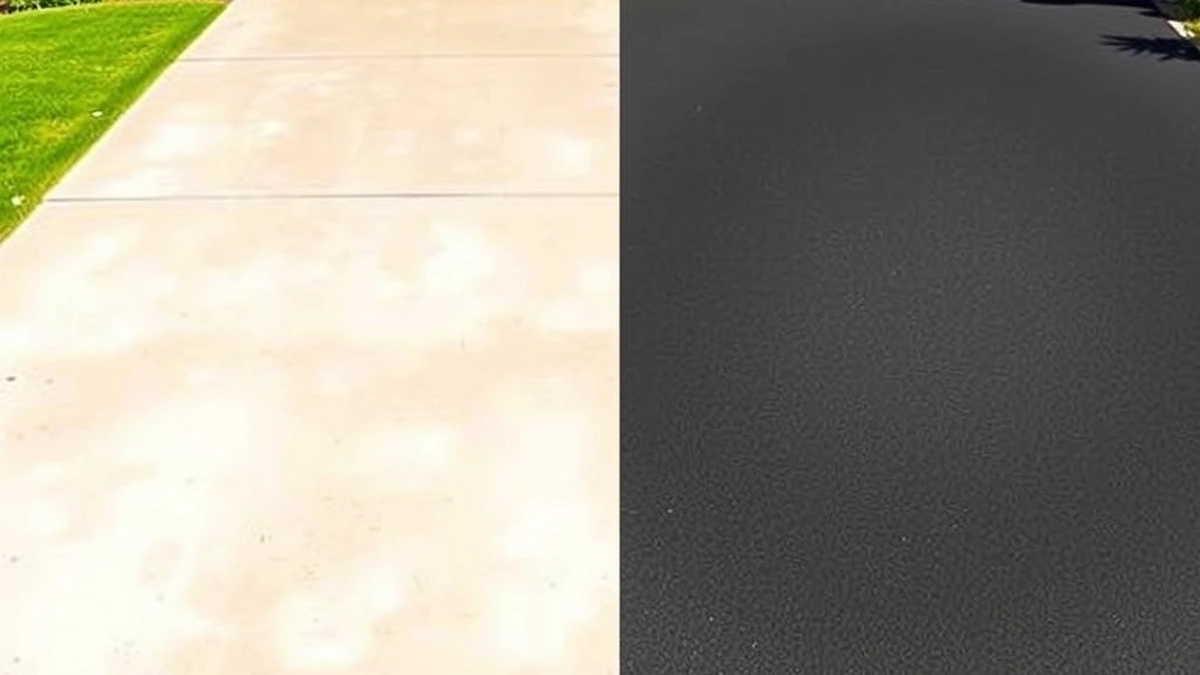
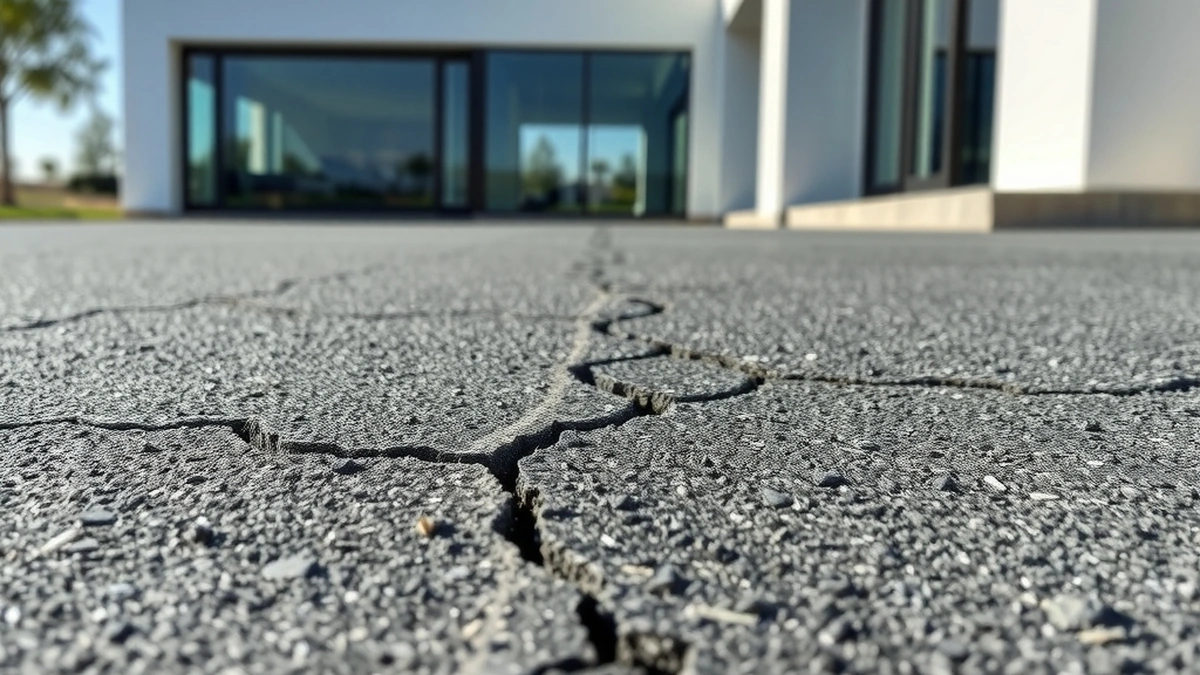
Coal tar sealer vs asphalt emulsion sealer
Coal tar against asphalt emulsion sealer on price, service life, fuel resistance, curing, and legal status, with worked cost comparisons for 1,000 sq ft.
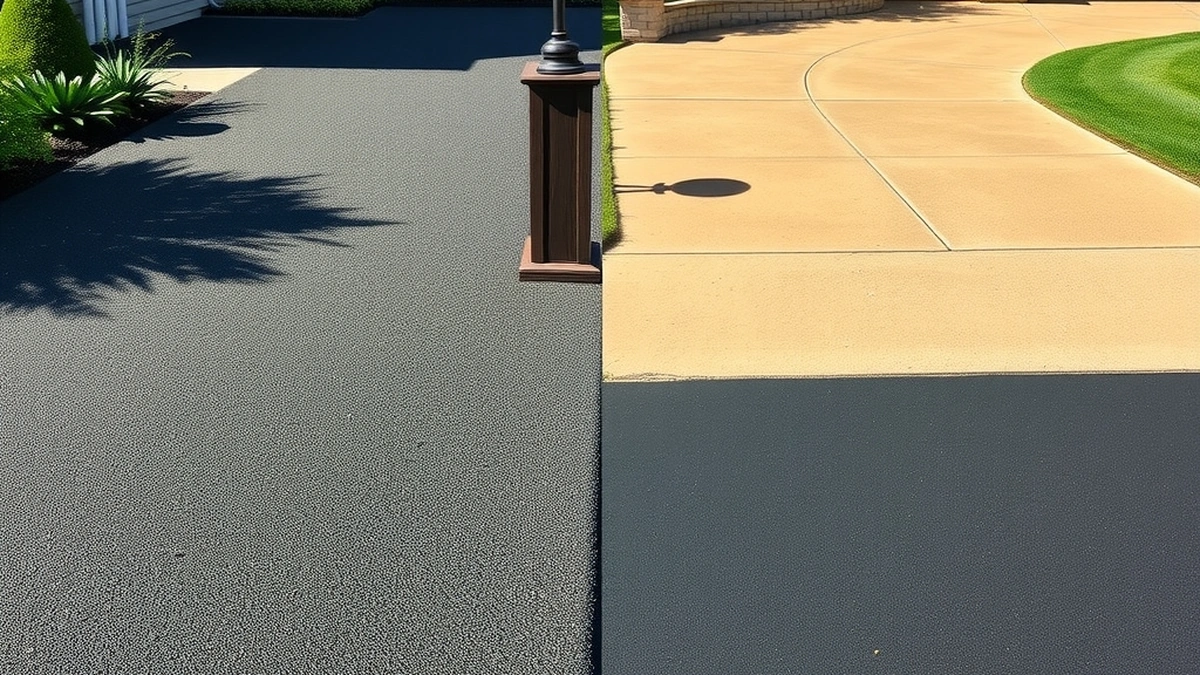
Coal tar resists fuel spills better and lasts three to four years, but it blushes, tracks in heat, and is restricted in some areas. Asphalt emulsion cures faster, needs recoating every two to three years, and is legal almost everywhere.
- Coal tar life
- 3-4 years
- Emulsion life
- 2-3 years
- Installed cost, both
- $0.15-0.30 per sq ft
- DIY material, both
- $0.05-0.12 per sq ft
Some links on this page are affiliate links.If you buy through them we may earn a commission at no extra cost to you. We do not accept payment for rankings. Read the full disclosure.
Coal tar and asphalt emulsion sealer sit in the same price band and do the same basic job, so the choice rarely turns on cost. It turns on three things: how long you want between recoats, whether the driveway collects oil and fuel, and whether coal tar is legal where you live. On a typical residential drive with no fuel spills, emulsion is the easier answer.
What each product is
Coal tar sealer is a water-based emulsion of refined coal tar, clay filler, and additives that cures into a dark, fuel-resistant film.
Asphalt emulsion sealer is a water-based suspension of asphalt particles and polymer that cures into a thinner, more flexible film with less fuel resistance.
Both are surface coatings. Neither repairs a base, fills a rut, or holds together alligator cracking. That distinction matters more than the product choice, because a failing driveway will shed either film within a season.
Head to head
| Attribute | Coal tar sealer | Asphalt emulsion sealer |
|---|---|---|
| Base material | Refined coal tar | Asphalt cement |
| Appearance | Deep black, holds colour longer | Black, greys faster |
| Recoat interval | 3-4 years | 2-3 years |
| Fuel and oil resistance | High | Moderate |
| Cure sensitivity | High; blushes in cool humid weather | Moderate; sensitive to rain |
| Heat performance | Softens and tracks | Softer film but less tracking |
| Odour during application | Strong | Mild |
| Regulatory status | Restricted in several states and municipalities | Widely permitted |
| Installed cost | $0.15-0.30 per sq ft | $0.15-0.30 per sq ft |
| DIY material cost | $0.05-0.12 per sq ft | $0.05-0.12 per sq ft |
The cost rows are identical on purpose. There is no meaningful price advantage in either direction at the rate level, and any quote that claims one is usually quoting different coat counts.
What the difference costs over ten years
Take a 1,000 square foot driveway and the top of the installed band, $0.30 per square foot, which is $300 per application (1,000 × $0.30 = $300).
Coal tar at a four-year interval gets two and a half applications per decade, so roughly $750. Emulsion at a two-and-a-half-year interval gets four applications, so roughly $1,200. The gap is about $450 over ten years, which is real but small against the alternatives: an overlay at $3 to $7 per square foot is $3,000 to $7,000 on the same area, and replacement at $8 to $15 per square foot is $8,000 to $15,000.
At the low end of the band, $0.15 per square foot, the same drive costs $150 per application, and the ten-year difference falls to about $225. These are estimates built from the rate bands, not quotes.
Fuel resistance is coal tar’s clear win
If vehicles park on the drive and leak, coal tar earns its place. Oil and gasoline soften an emulsion film faster, and repeated spills will lift it in patches long before the service interval is up.
Emulsion defenders point out that a spill wiped up promptly damages neither product. That is true, and on a driveway where the owner notices spills, the advantage narrows to almost nothing. Where the drive is a working surface for equipment or older vehicles, it matters.
The availability problem
Coal tar carries high levels of polycyclic aromatic hydrocarbons, and runoff from sealed pavement is a documented water-quality issue. Several states and municipalities restrict or ban sales, and some regulate application near storm drains.
That constraint decides the question in a growing number of places. If you cannot buy the product locally, the comparison is settled before it starts. Types of driveway sealing covers the alternatives, including acrylic systems for decorative and lighter-duty work.
Choosing between them
- Check local rules first. If coal tar is restricted, choose emulsion and stop there.
- Count the oil leaks. A driveway with recurring drips favours coal tar where it is legal.
- Decide the recoat interval you will actually keep. A three to four year cycle only pays if you maintain it; a neglected coal tar coat is no better than a fresh emulsion one.
- Price both at the same coat count. Two coats is the standard for either product, so compare like with like.
- Check the cure window against the forecast. Emulsion needs dry weather; coal tar needs dry weather and warmth.
Whichever product you choose, the interval is the number that governs the annual cost, and how often to seal an asphalt driveway sets the outer limit on it. Coal tar sealer cost breaks the installed rate down by driveway size so the two products can be compared on the same square footage.
Where neither is the answer
Both products are the wrong purchase on a base that has failed. Potholes at $100 to $400 each, depressions, and alligator cracking belong to driveway sealing repair, not to a sealer comparison. Crack filling at $2 to $5 per linear foot is the one repair that belongs in either scope, and skipping it undermines both films equally.
Coal tar vs emulsion, in one line: coal tar buys a slightly longer interval and better fuel resistance at the cost of availability and heat performance; emulsion buys convenience and legality at the cost of one extra recoat per decade. On most residential driveways, that extra recoat is the cheaper compromise.
Frequently asked questions
Is coal tar sealer better than asphalt emulsion?
Better at fuel resistance and slightly longer service life. Worse at availability, odour, and heat performance. Emulsion is better where coal tar is restricted or the driveway sees little oil.
Which lasts longer on a residential driveway?
Coal tar, at three to four years against two to three for emulsion. The gap is one recoat per decade, which is worth roughly $150 to $300 on a 1,000 square foot drive.
Do the two products cost the same to install?
Both fall in the $0.15 to $0.30 per square foot installed band. Coal tar quotes often land at the higher end because it is applied heavier and fewer contractors still carry it.
Can I put emulsion over an old coal tar coat?
Only if the coal tar film is sound, clean, and fully cured. If it is flaking or blushing with a failed bond, it has to be removed first or the new coat lifts with it.
Why is coal tar banned in some places?
Coal tar contains high levels of polycyclic aromatic hydrocarbons, and runoff from sealed surfaces is a water-quality concern. Several states and municipalities restrict or ban sales.
Which is better for a driveway with oil leaks?
Coal tar, if it is legal in your area. It resists gasoline and oil better than emulsion, which softens faster under repeated spills even when the film is intact.
Sources
Some links are affiliate links.If you buy through them we may earn a commission at no extra cost to you. We do not accept payment for rankings. Read the full disclosure.