Asphalt emulsion sealer vs coal tar sealer
Emulsion and coal tar sit in the same $0.15-$0.30 per sq ft band. Compare life, fuel resistance, cure behaviour, regulation, and ten-year cost of ownership.
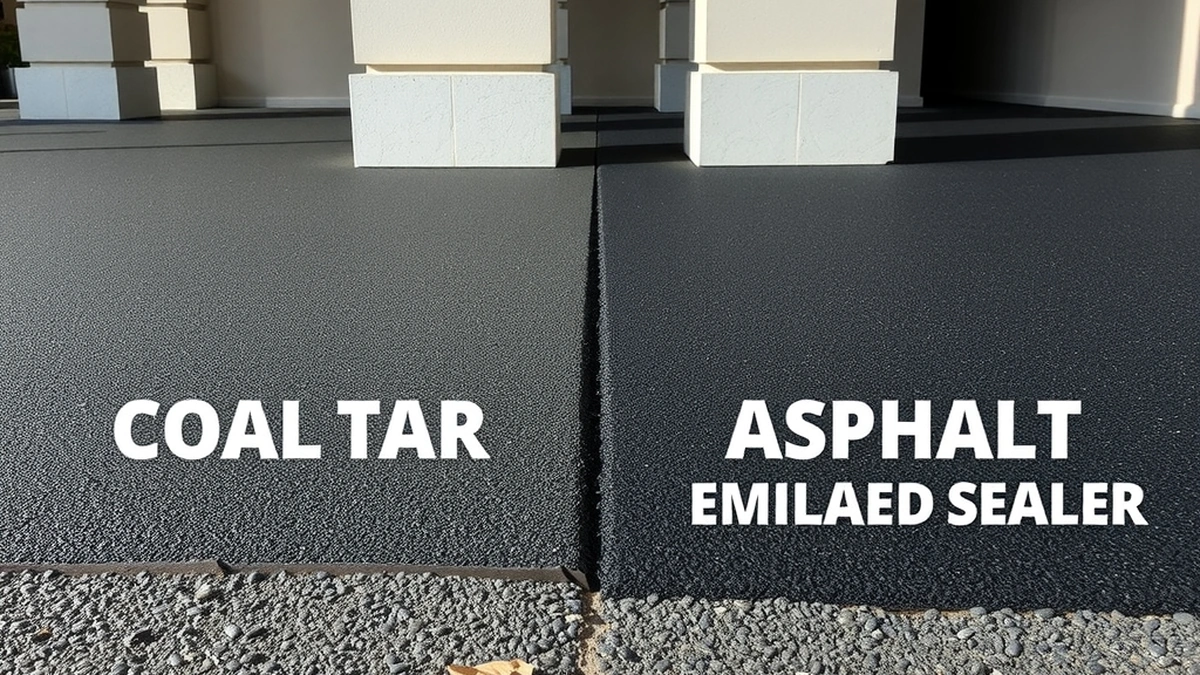
Coal tar sealer resists fuel spills and lasts three to four years; asphalt emulsion lasts two to three and cures faster with less odour. Both cost $0.15 to $0.30 per square foot installed, and coal tar is restricted in some states and municipalities.
- Emulsion life
- 2-3 years
- Coal tar life
- 3-4 years
- Installed cost, both
- $0.15-$0.30 per sq ft
- Material cost, both
- $0.05-$0.12 per sq ft
- Coal tar status
- Restricted in some areas
Some links on this page are affiliate links.If you buy through them we may earn a commission at no extra cost to you. We do not accept payment for rankings. Read the full disclosure.
Asphalt emulsion and coal tar sealer cost the same per square foot and are applied the same way, so the decision comes down to four things: how long each lasts, how each handles fuel, whether coal tar is legal where you live, and how each behaves in cool weather. For most residential driveways, emulsion is the default and coal tar is the upgrade for a specific problem.
What each product is
Asphalt emulsion sealer is a water-based suspension of asphalt particles, clay filler, and additives that cures into a black protective film.
Coal tar sealer is a water-based emulsion of refined coal tar with similar fillers, curing into a darker, denser, more fuel-resistant film.
Both are surface coatings. Neither repairs a base, fills a rut, or holds together alligator cracking. That shared limitation matters more than the differences below.
Head to head
| Attribute | Asphalt emulsion | Coal tar |
|---|---|---|
| Base material | Asphalt cement | Refined coal tar |
| Colour | Black, greys in 2-3 years | Deep black, holds longer |
| Recoat interval | 2-3 years | 3-4 years |
| Fuel and oil resistance | Moderate | High |
| Cure in cool weather | Tolerant | Prone to blushing |
| Odour | Mild | Strong |
| Regulatory status | Widely permitted | Restricted in some areas |
| Installed cost | $0.15-$0.30 per sq ft | $0.15-$0.30 per sq ft |
| Material cost | $0.05-$0.12 per sq ft | $0.05-$0.12 per sq ft |
The identical cost rows are not a simplification. At the rate level there is no meaningful price difference, and a quote that claims one is usually quoting different coat counts or different preparation.
Ten years of ownership
Take a 1,000 square foot driveway at $0.22 per square foot installed, which is $220 per coat.
Emulsion at a three-year interval: about 3.3 coats, $726. Coal tar at a four-year interval: 2.5 coats, $550.
Difference: $176 over a decade, or about $18 a year. That is the entire financial case for coal tar, and it assumes the coal tar is applied correctly. In cool, humid weather it blushes, and a blush usually means a recoat, which erases the saving.
In materials at $0.08 per square foot, the same driveway is $80 per coat: $264 for emulsion over the decade against $200 for coal tar.
Where each product earns its price
Three situations justify coal tar.
Fuel exposure. A driveway used by a diesel truck, a tractor, or a vehicle that marks its spot with oil benefits from the higher resistance. Coal tar resists gasoline and oil far better than emulsion.
Appearance. Coal tar’s deeper black holds longer, which matters on a visible front driveway where the greying of emulsion is noticed within two years.
Longer interval. Where the driveway is large and each recoat is expensive, the extra year between coats is worth real money. On 2,000 square feet at $0.22, one avoided coat is $440.
Outside those, the extra year rarely justifies the odour, the cure sensitivity, and the regulatory risk.
Where emulsion wins.
Emulsion is the right choice in four common cases.
Coal tar is restricted. Several states and municipalities limit or ban coal tar sales because of polycyclic aromatic hydrocarbon runoff. Check locally before ordering; a contractor who carries it will know.
The driveway sees little fuel. Without oil exposure, coal tar’s main advantage does not apply.
The work is scheduled in shoulder season. Emulsion tolerates cooler, more humid conditions better than coal tar, which blushes.
Odour matters. Coal tar smells strongly for days. On a shared driveway or a property with close neighbours, that is a real cost.
Application differences that matter
Both products are spread with a squeegee or sprayer at the manufacturer’s rate, and both need a clean, dry surface above 50 F.
Coal tar is applied heavier, which is part of why it lasts longer. It also takes longer to cure and is more sensitive to moisture during that window. A 48-hour dry forecast is the minimum for either; coal tar wants a longer one.
Neither bonds reliably over a sound film of the other. If you switch products, the old coat has to be removed or the new one lifts. Test a small patch if the history of the driveway is unknown.
The regulatory question
Coal tar restrictions vary and change. The practical approach is to ask three questions before buying.
Is the product legal to sell in this state or municipality? Does the contractor carry it, and do they know the local rule? Does the runoff from the driveway reach a storm drain or a watercourse?
Where coal tar is restricted, emulsion is the compliant choice, and the performance difference is one year of service life.
How to decide in four steps
- Check local rules on coal tar sales and use.
- Assess fuel exposure: does anything leak or park with oil?
- Check the driveway coating history, because switching products requires removal.
- Compare the ten-year cost using the recoat intervals above.
For most driveways with no fuel exposure and no local restriction, emulsion at $0.15 to $0.30 per square foot every three years is the straightforward answer. For a driveway with oil, a visible frontage, and a legal supply, coal tar’s extra year and deeper colour earn their place.
What neither product will do
Both are maintenance coatings. A driveway with alligator cracking, ponding water, or soft spots needs an overlay at $3 to $7 per square foot or replacement at $8 to $15, not a sealer.
Applying either product over a failing surface produces a uniform finish for a season and then re-cracks along the same lines. Our alligator cracking repair guide covers that diagnosis, and driveway sealing repair explains how to separate surface wear from base failure. For pricing, see driveway sealing cost and coal tar sealer cost.
Frequently asked questions
Is coal tar sealer better than asphalt emulsion?
For fuel resistance and service life, yes. For availability, odour, and cure tolerance, no. Emulsion is the safer default where coal tar is restricted or the driveway sees little oil.
How much longer does coal tar last?
Three to four years against two to three for emulsion. Over a decade that is roughly one extra recoat avoided, worth $150 to $300 on a 1,000 square foot driveway.
Do both products cost the same?
At the rate level, yes: $0.15 to $0.30 per square foot installed, and $0.05 to $0.12 in materials. Coal tar quotes often land at the top of the band because it is applied heavier.
Why is coal tar restricted in some states?
It contains high levels of polycyclic aromatic hydrocarbons, and runoff from sealed pavement is a water-quality concern. Several states and municipalities restrict or ban sales.
Can emulsion go over an old coal tar coat?
Only if the coal tar film is sound, clean, and fully cured. If it is flaking or blushing, it has to be removed first, because the new coat lifts with it.
Which is better for a driveway with oil leaks?
Coal tar, where it is legal. It resists gasoline and oil better than emulsion, which softens under repeated spills even when the film is intact.
Sources
Some links are affiliate links.If you buy through them we may earn a commission at no extra cost to you. We do not accept payment for rankings. Read the full disclosure.