Edge crumbling: repair options for driveway edges
Crumbling driveway edges are a support and drainage failure. Repair options: shoulder rebuild, edge patching, curb, and overlay, with costs and decision rules.
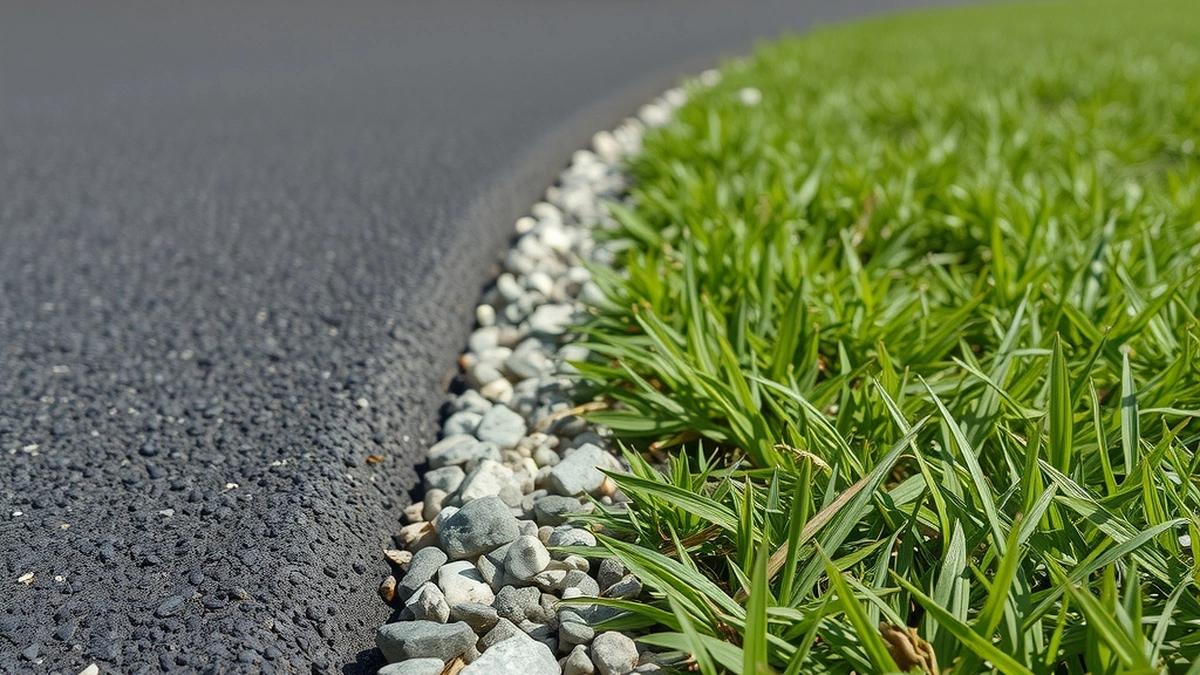
Crumbling driveway edges are repaired by rebuilding the shoulder so the pavement is supported, cutting back and patching the broken section, adding a curb or edging, or overlaying when the failure runs the length of the drive. Sealer alone will not hold an unsupported edge.
- Edge patch
- $100-$400 per section
- Overlay
- $3-$7 per sq ft
- Replacement
- $8-$15 per sq ft
- Sealer
- Not an edge repair
- Root cause
- Missing shoulder support
Some links on this page are affiliate links.If you buy through them we may earn a commission at no extra cost to you. We do not accept payment for rankings. Read the full disclosure.
Crumbling driveway edges are a support failure, not a surface one. The pavement at the perimeter has no compacted shoulder holding it, so water gets under it and traffic breaks it away. Repair means rebuilding that support and patching the broken section — sealing over it does nothing.
Why edges fail
An asphalt driveway is only as strong at its edge as the material beside it.
In the middle of the drive, the pavement is confined by more pavement. At the edge, it meets soil, gravel, or lawn. If that transition is not built up and compacted, three things happen.
Water runs along the joint and under the pavement. Traffic loads the unsupported lip. The lip cracks, breaks, and the failure moves inward.
That is why edge crumbling is nearly always worse in winter and after wet spells.
Repair options compared
| Option | What it does | Cost | Best for |
|---|---|---|---|
| Sealcoat only | Covers the surface | $0.15-$0.30 per sq ft | Not a repair |
| Edge patch | Replaces broken asphalt | $100-$400 per section | Localised breakdown |
| Shoulder rebuild | Restores support | Priced with the patch | Every edge repair |
| Edging or curb | Holds the shoulder | Varies with material | Prevention after repair |
| Overlay | New surface across the drive | $3-$7 per sq ft | Failure along the length |
| Replacement | New pavement and base | $8-$15 per sq ft | Base failed across the width |
The row that matters most is the second. A patch without a shoulder rebuild is a patch on an unsupported edge, and it will break again.
What a proper edge repair involves
- Cut the broken asphalt back to sound material with a square edge.
- Remove loose base and any soft soil at the perimeter.
- Add and compact aggregate to rebuild the shoulder.
- Place asphalt in the cut section and compact it to match the grade.
- Seal the joint and restore the shoulder material beside it.
Step 3 is the one that gets skipped in cheap repairs, and it is the reason the failure returns.
Cost of the options, worked through
A localised edge failure 10 feet long and 1 foot wide is 10 square feet. Priced like a pothole repair at $100 to $400 per section, that is the realistic range, because the work is labor and base correction rather than material.
If the edge has failed along the full 30-foot length of a driveway, patching is no longer the answer. An overlay at $3 to $7 per square foot on a 600 square foot driveway is $1,800 to $4,200, and it replaces the surface across the width rather than chasing the edge.
If the base under the edge has failed across the driveway, replacement at $8 to $15 per square foot is $4,800 to $9,000 on 600 square feet.
The step from $400 to $1,800 happens when the failure stops being local. The decision point is easy to measure: walk the edge with a tape and add up the failed length. Under about 10 feet, patch it. Over about 30 feet on a 600 square foot driveway, the overlay covers more surface for a similar total and resets the edge support at the same time.
Why sealing makes it worse
Sealer bonds to sound asphalt. On a crumbling edge, the asphalt is loose and the base beneath it is wet.
A coat applied over that edge cures as a film bridging a void. Traffic breaks the film, water enters at the break, and the edge fails faster than before because the film held water against the pavement.
If a contractor offers to “seal the edges to stop the crumbling”, the question to ask is what support is being added. If the answer is none, the seal is cosmetic.
When to add edging or a curb
Edging and curbs help after the support is restored, not instead of restoring it.
A paver edge set in concrete holds the shoulder material and prevents it washing away. A poured concrete curb does the same more robustly and at higher cost.
Both also stop vehicles from running off the edge and breaking the lip, which is a common cause of repeat failure on narrow driveways.
Neither compensates for a base that was never compacted. If the edge keeps failing after a proper repair, the base under the pavement is the next thing to investigate.
When the whole edge is gone
Three conditions point to a bigger repair.
The failure runs the length of the driveway rather than appearing in one or two spots.
The pavement is breaking back more than a few inches across the width.
The surface beside the failed edge is also cracked or settled, so the problem is not confined to the perimeter.
In those cases an overlay at $3 to $7 per square foot is the economical repair, and replacement at $8 to $15 is the durable one if the base has failed.
Prevention after the repair
Three habits keep a repaired edge intact.
Maintain the shoulder. Top up soil or gravel beside the pavement so the edge is supported rather than exposed.
Keep water off the joint. Grade the lawn away from the driveway, and make sure downspouts discharge well clear.
Avoid loading the lip. Keep vehicle wheels on the pavement, and avoid parking with one side on the lawn.
Those cost little and prevent most repeat failures. Our edge crumbling prevention guide covers the routine, and edge crumbling cost prices each repair option by extent. For the wider picture on base failures, see alligator cracking repair.
Frequently asked questions
How do you repair a crumbling driveway edge?
Rebuild the shoulder so the pavement has support, cut away the broken asphalt, patch the section with compacted asphalt, and seal the joint. Adding edging or a curb prevents a repeat.
Why does the edge of my driveway keep crumbling?
Because it has no support. Where pavement meets soil without a compacted shoulder, water gets under the edge and traffic breaks it away. Patching without fixing the support fails again.
Can I just seal a crumbling edge?
No. Sealer is a surface film and cannot support a failing edge. A coat over crumbling asphalt lifts within a season and hides nothing structural.
How much does edge repair cost?
A localised edge patch is typically priced like a pothole repair, $100 to $400 per section. An overlay across the driveway is $3 to $7 per square foot, and replacement is $8 to $15.
Does edging or a curb stop edge crumbling?
It helps by holding the shoulder material and preventing traffic from running off the edge. It does not replace proper base compaction, which is what actually supports the pavement.
When should I replace instead of repair the edge?
When the edge failure runs the full length of the driveway, when the pavement is breaking back more than a few inches, or when the base under the edge has failed across the width.
Sources
Some links are affiliate links.If you buy through them we may earn a commission at no extra cost to you. We do not accept payment for rankings. Read the full disclosure.