Edge crumbling: warning signs to act on
The signs a driveway edge is failing: a visible gap at the joint, loose aggregate, a soft shoulder, and cracks running parallel to the perimeter.
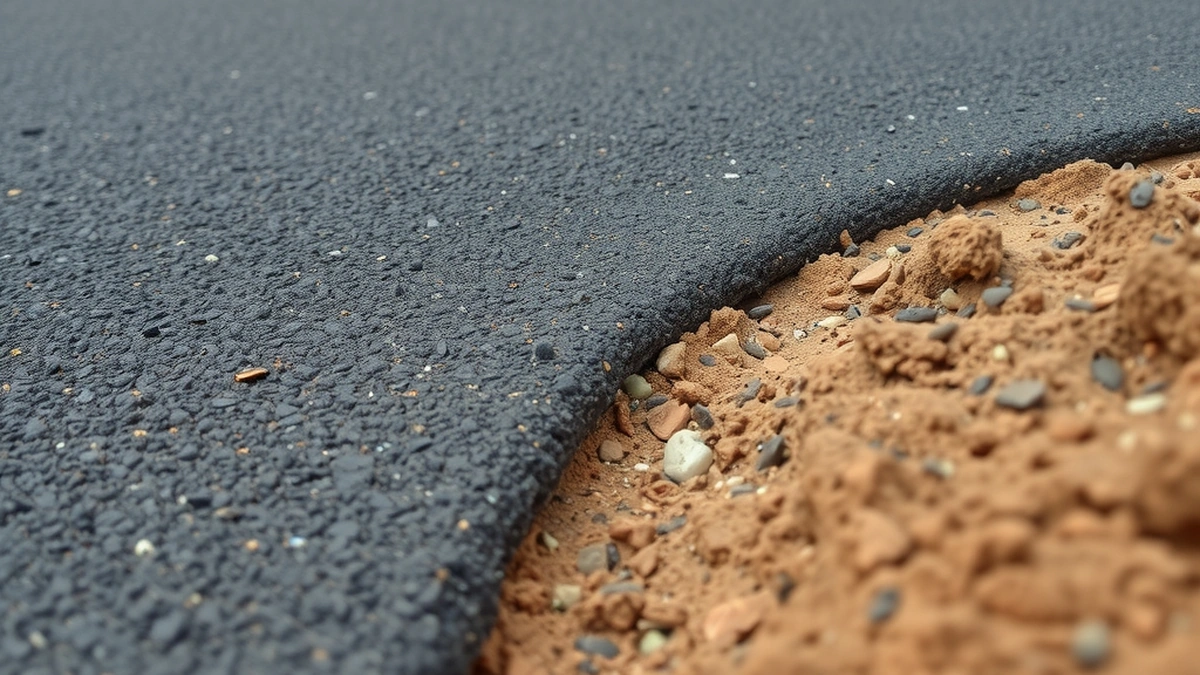
The warning signs of edge crumbling are a visible gap between asphalt and shoulder, loose aggregate beside the pavement, a soft shoulder underfoot, and cracks running parallel to the edge. Catching them while the gap is narrow means a support repair rather than a patch.
- First sign
- Gap at the joint
- Second sign
- Soft shoulder
- Third sign
- Parallel cracks
- Repair cost
- $100-$400 per section
- Overlay
- $3-$7 per sq ft
Some links on this page are affiliate links.If you buy through them we may earn a commission at no extra cost to you. We do not accept payment for rankings. Read the full disclosure.
The first sign of a crumbling driveway edge is usually a narrow gap between the asphalt and the shoulder, often with loose gravel sitting in it. By the time pieces of pavement are breaking away, the edge has been unsupported for a season or more. The signs below appear in order, and the earlier you catch them the cheaper the fix.
What the edge is doing
A driveway edge is the boundary where confined pavement meets unconfined soil.
In the middle of the drive, load spreads into more pavement. At the edge, load spreads into whatever is beside it. If that material is loose, soft, or missing, the edge flexes and eventually breaks.
Everything in the warning list below is a symptom of that loss of support.
The signs in order
| Stage | Sign | What it indicates | Action |
|---|---|---|---|
| 1 | Narrow gap at the joint | Shoulder shrinking away | Top up and compact |
| 2 | Loose gravel in the gap | Shoulder washing out | Rebuild shoulder |
| 3 | Soft shoulder underfoot | Water in the shoulder | Fix drainage, rebuild |
| 4 | Crack parallel to the edge | Unsupported edge flexing | Repair edge and support |
| 5 | Edge pieces breaking away | Pavement failing | Patch at $100-$400 |
| 6 | Failure moving inward | Base under edge lost | Overlay or replacement |
Stage 1 costs an hour and a bag of aggregate. Stage 5 costs $100 to $400 per section. Stage 6 is measured in thousands.
Shoulder material compacts, washes, or blows away over time. Soil shrinks in dry weather, and gravel migrates under traffic.
As the shoulder recedes, a gap opens at the joint. Water collects in it, which is the worst possible outcome: the gap both admits water and removes the support that would keep the edge from flexing.
The gap is also self-widening. Water running along the joint scours the shoulder material further, and each freeze pushes the pavement edge a little further out.
Why the gap appears and why parallel cracks follow
Cracks that run along the driveway, parallel to the edge and a few inches in from it, are a specific sign.
They indicate that the pavement is flexing where support ends. Traffic loading across the driveway produces transverse cracks; edge failure produces longitudinal ones.
If a longitudinal crack appears and the shoulder beside it is soft or missing, the diagnosis is edge support, not surface ageing. Filling the crack without fixing the support buys one season.
Testing the shoulder
Three quick tests tell you whether the edge is at risk.
Press a boot into the shoulder beside the pavement. Sinking means soft, saturated material.
Pour a cup of water at the joint and watch. If it disappears quickly into the gap, the shoulder is porous and water is reaching the base.
Push a screwdriver horizontally into the gap. If it slides in several inches, there is a void under the edge.
Any of those three plus a visible gap is enough to act. Our edge crumbling repair guide covers the repair sequence.
What the signs cost to address
Stage 1, topping up and compacting the shoulder: a bag or two of aggregate and an hour of work.
Stage 2, rebuilding a washed-out shoulder: more material and compaction, still a small job.
Stage 4, repairing a parallel crack and the support beneath it: crack filling at $2 to $5 per linear foot plus shoulder work.
Stage 5, patching a broken edge section: $100 to $400.
Stage 6, an overlay at $3 to $7 per square foot: $1,800 to $4,200 on 600 square feet.
The progression is steep, and it is entirely predictable from stage 1.
The signs that are not edge failure
Three lookalikes get misread.
Settlement of the whole driveway. If the pavement is sinking uniformly rather than breaking at the perimeter, the issue is the base, not the shoulder.
Cracking from tree roots. Roots lift pavement in a localised area, often with a hump rather than a gap at the edge.
Surface raveling at the edge. Loss of binder makes the edge look rough but the pavement stays supported. That is a sealing issue, not a support issue.
The distinguishing test is the gap. Edge failure has one; the others do not.
When the signs mean the whole edge is gone
Four conditions point past a local repair.
The gap and parallel cracking run the length of one or both sides.
The pavement is breaking back more than a few inches across the width.
The surface beside the edge is also cracked or settled.
Water stands along the edge after rain and cannot be graded away.
In those cases, an overlay at $3 to $7 per square foot is the economical repair, and replacement at $8 to $15 is the durable one if the base has failed.
What to record
A ten-minute inspection twice a year, with a photo of each edge and a note of any gap width, is enough to catch the progression early.
- Photograph each edge from the same spot, including a tape measure in frame.
- Record the gap width in inches at three points along each side.
- Note whether the shoulder is soft, firm, or washed out.
- Mark the date and any repair done since the last check.
- Compare with the previous set before deciding whether to act.
Record the date, the location, and whether the shoulder was soft. Next spring’s comparison then tells you whether the repair worked, rather than relying on memory.
Our edge crumbling prevention guide covers the routine that keeps stage 1 from progressing, and edge crumbling cost prices each stage of repair.
Frequently asked questions
What are the first signs of a crumbling driveway edge?
A narrow gap between the asphalt and the shoulder, loose gravel or soil beside the pavement, and a shoulder that feels soft underfoot. Cracks parallel to the edge follow if nothing is done.
Why do cracks run parallel to the driveway edge?
Because the unsupported edge flexes and cracks along the line where support ends. A longitudinal crack near the perimeter is a classic sign of edge failure rather than traffic loading.
Is a gap at the edge serious?
It is the beginning of one. Water enters the gap, softens the shoulder, and the edge breaks away. Filling and rebuilding the shoulder early prevents the patch that follows.
Can I fill the gap with sealer?
No. Sealer is a thin film and cannot bridge a structural gap or restore support. The shoulder has to be rebuilt with compacted material.
How do I test whether the shoulder is soft?
Press a boot or a screwdriver into the shoulder beside the pavement. If it sinks easily or water appears, the material is saturated and the edge is at risk.
When does an edge sign mean the whole driveway needs work?
When the gap and cracks run the length of one or both sides, or when the pavement is breaking back more than a few inches across the width.
Sources
Some links are affiliate links.If you buy through them we may earn a commission at no extra cost to you. We do not accept payment for rankings. Read the full disclosure.