Asphalt emulsion sealer cost: pails and rates
Asphalt emulsion sealer costs $0.05 to $0.12 per sq ft in materials and $0.15 to $0.30 installed. Pail coverage, solids, and real cost per square foot.
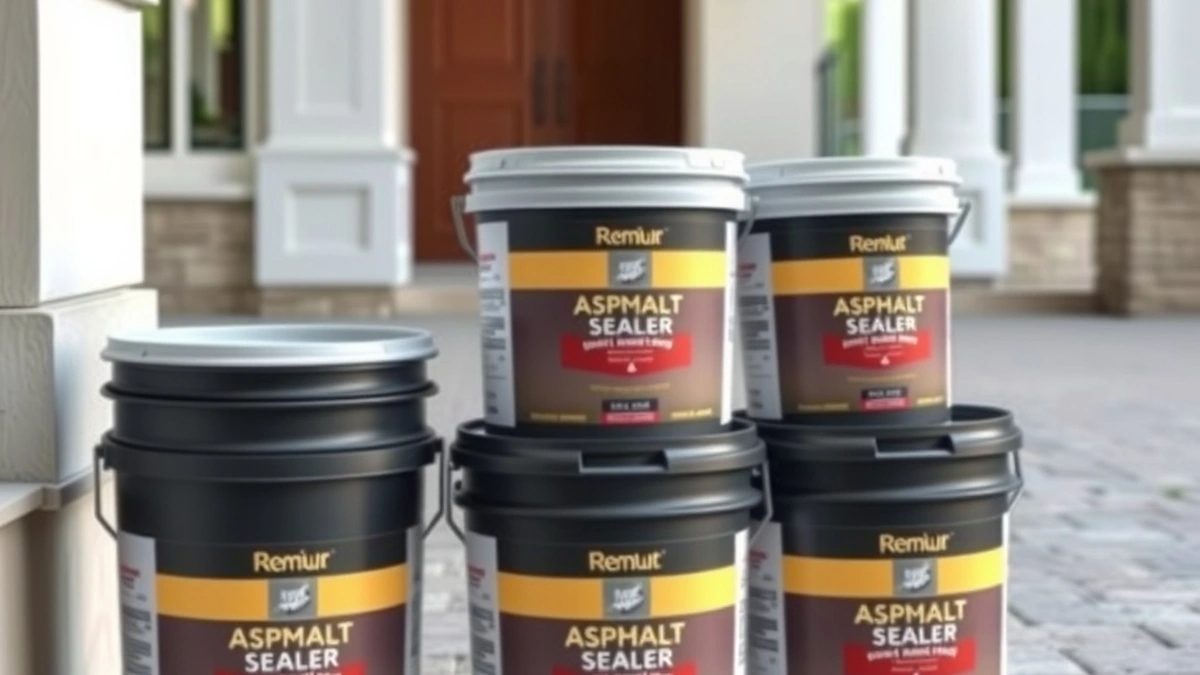
Asphalt emulsion sealer costs $0.05 to $0.12 per square foot in materials, or $0.15 to $0.30 per square foot installed. A 5-gallon pail covers roughly 250 to 400 square feet, so a 700 square foot driveway needs two pails at about $35 to $84 total.
- Material cost
- $0.05-$0.12 per sq ft
- Installed cost
- $0.15-$0.30 per sq ft
- 5-gallon pail coverage
- 250-400 sq ft
- 700 sq ft materials
- $35-$84
- Recoat interval
- 2-3 years
Some links on this page are affiliate links.If you buy through them we may earn a commission at no extra cost to you. We do not accept payment for rankings. Read the full disclosure.
Asphalt emulsion sealer costs $0.05 to $0.12 per square foot in materials, or $0.15 to $0.30 per square foot installed. A 5-gallon pail covers about 250 to 400 square feet, so a 700 square foot driveway takes two pails and $35 to $84 of product. The variable that moves that number most is not the brand; it is the coverage you actually achieve on your surface.
What the product is and what it costs
Asphalt emulsion sealer is a water-based suspension of asphalt particles, filler, and additives that cures into a protective black film over asphalt pavement.
It is sold by the pail, usually 4.75 to 5 gallons, and priced per gallon in bulk for contractors. The material cost band of $0.05 to $0.12 per square foot assumes coverage at the label rate on a surface of average porosity.
Two things shift the real cost within that band. Coverage is one. Solids content is the other. A pail with higher solids lays down more film per gallon, so a higher price per pail can still be the cheaper product per square foot.
Cost by driveway size
| Driveway | Area | Pails needed | Material at $0.05 | Material at $0.12 | Installed at $0.15 | Installed at $0.30 |
|---|---|---|---|---|---|---|
| Small | 300 sq ft | 1 | $15 | $36 | $45 | $90 |
| One car | 400 sq ft | 1-2 | $20 | $48 | $60 | $120 |
| Two car | 600 sq ft | 2 | $30 | $72 | $90 | $180 |
| Two car, long | 800 sq ft | 2-3 | $40 | $96 | $120 | $240 |
| Wide pad | 1,200 sq ft | 3-4 | $60 | $144 | $180 | $360 |
The pail count assumes 300 square feet per pail, the middle of the coverage range. A 700 square foot drive at 300 square feet per pail needs 2.33 pails, which means buying three or accepting a thinner second coat.
Never stretch the last pail. To price a job properly:
- Measure the driveway in square feet, including the apron.
- Divide by the pail’s stated coverage to get the pail count, then round up.
- Add crack filler at $2 to $5 per linear foot for any cracks.
- Add primer, cleaner, and tools if you are doing the work yourself.
- Compare the total against the installed rate before deciding to hire out. A coat applied below the label rate dries thin, wears through in the tire tracks within a season, and costs more in the long run than the extra pail.
Cost per square foot, worked through
Take a 700 square foot driveway and a 5-gallon pail priced at $30 with a label coverage of 350 square feet.
At label coverage: 700 ÷ 350 = 2 pails, $60 total, $60 ÷ 700 = $0.086 per square foot.
On rough, porous asphalt at 250 square feet per pail: 700 ÷ 250 = 2.8 pails, so 3 pails, $90 total, $90 ÷ 700 = $0.129 per square foot.
That is a 50 percent increase from coverage alone, with the same product and the same price per pail. It is also why contractor quotes vary: the crew knows the surface will drink more material and prices accordingly.
Add the consumables and the DIY figure moves again. A squeegee or brush, a pour pot, driveway cleaner, oil spot primer, and protective gloves add roughly $40 to $80 for a first-time job. On 700 square feet that is another $0.06 to $0.11 per square foot, which puts DIY close to the low end of the installed range.
Materials versus installed price
The installed rate of $0.15 to $0.30 per square foot is roughly two to three times the material cost. The difference is labor, equipment, insurance, and the cleaning that makes the coat bond.
For a 700 square foot driveway: materials at $0.086 per square foot are $60. Installed at $0.22 per square foot is $154. The $94 difference buys a crew, a sprayer or squeegee, surface preparation, and a return visit if rain ruins the cure.
DIY wins on small, clean, sound driveways where you already own a pressure washer and a free weekend. It loses on large driveways, steep slopes, and any surface that needs extensive crack filling first, because those are the hours that make the job unpleasant. Our DIY driveway sealing guide sets out the equipment list.
What a second coat adds
A second coat roughly doubles material and adds 40 to 60 percent to a contractor invoice, because mobilization and preparation are already paid for.
On 700 square feet, one coat at $154 installed becomes roughly $215 to $245 for two. In materials, $60 becomes about $120.
The second coat earns its money on porous, sun-bleached asphalt that drinks the first pass and still looks grey. It earns less on a surface sealed within the last three years, where the film is already continuous.
Comparing emulsion with the alternatives
| Product | Material cost | Installed cost | Recoat interval |
|---|---|---|---|
| Asphalt emulsion | $0.05-$0.12 per sq ft | $0.15-$0.30 per sq ft | 2-3 years |
| Coal tar emulsion | $0.05-$0.12 per sq ft | $0.15-$0.30 per sq ft | 3-4 years |
| Acrylic sealer | $0.05-$0.12 per sq ft | $0.15-$0.30 per sq ft | 1-3 years |
The bands are identical on purpose. There is no meaningful price advantage between the three at the rate level, and a quote that claims one is usually quoting different coat counts or different preparation.
Over ten years the interval matters more than the rate. Emulsion at three-year cycles is about three coats; coal tar at four-year cycles is about two and a half. On 700 square feet at $0.086 per square foot in materials, that is $180 against $150 — a $30 difference across a decade. Not a reason to choose either product on its own.
Where the money is wasted
Emulsion sealer applied over a failing surface is the most common waste in this category. Alligator cracking across more than a quarter of the driveway, ponding water, or soft spots underfoot all mean the base has a problem that no coating fixes.
A fresh coat over that damage looks uniform for one season and then re-cracks along the same lines. The $60 to $150 spent on material would have been better put toward an overlay at $3 to $7 per square foot or replacement at $8 to $15.
The other waste is dilution. Adding water beyond the label rate to stretch coverage produces a thin film that wears through in the tracks within a year. If the budget is tight, seal half the driveway properly rather than all of it thinly.
For application detail, see asphalt emulsion sealer installation. For the failures that follow a bad coat, asphalt emulsion sealer problems covers the symptoms and their causes.
Frequently asked questions
How much does asphalt emulsion sealer cost?
Materials run $0.05 to $0.12 per square foot, and installed work runs $0.15 to $0.30 per square foot. A 700 square foot driveway costs $35 to $84 in sealer or $105 to $210 installed.
How many square feet does a 5-gallon pail cover?
Roughly 250 to 400 square feet in one coat on typical asphalt. Porous or badly weathered surfaces take the lower figure; smooth, previously sealed surfaces take the higher one.
Is asphalt emulsion cheaper than coal tar sealer?
The two sit in the same band, $0.05 to $0.12 per square foot in materials and $0.15 to $0.30 installed. Coal tar often quotes slightly higher because it is applied heavier and fewer contractors carry it.
Why is the cost per square foot higher than the pail price suggests?
Because coverage is lower than the label's best case. A pail claiming 400 square feet may cover 250 on rough asphalt, which raises the true material cost by 60 percent.
Does a second coat double the material cost?
It roughly doubles material but not labor. Expect 40 to 60 percent more on a contractor invoice, and about double on a DIY receipt, because you buy the pails yourself.
When is emulsion the wrong choice?
When coal tar is legal and the driveway sees heavy fuel spills, or when the surface is already failing. Neither product fixes a failed base, and sealer over alligator cracking is wasted money.
Sources
Some links are affiliate links.If you buy through them we may earn a commission at no extra cost to you. We do not accept payment for rankings. Read the full disclosure.